
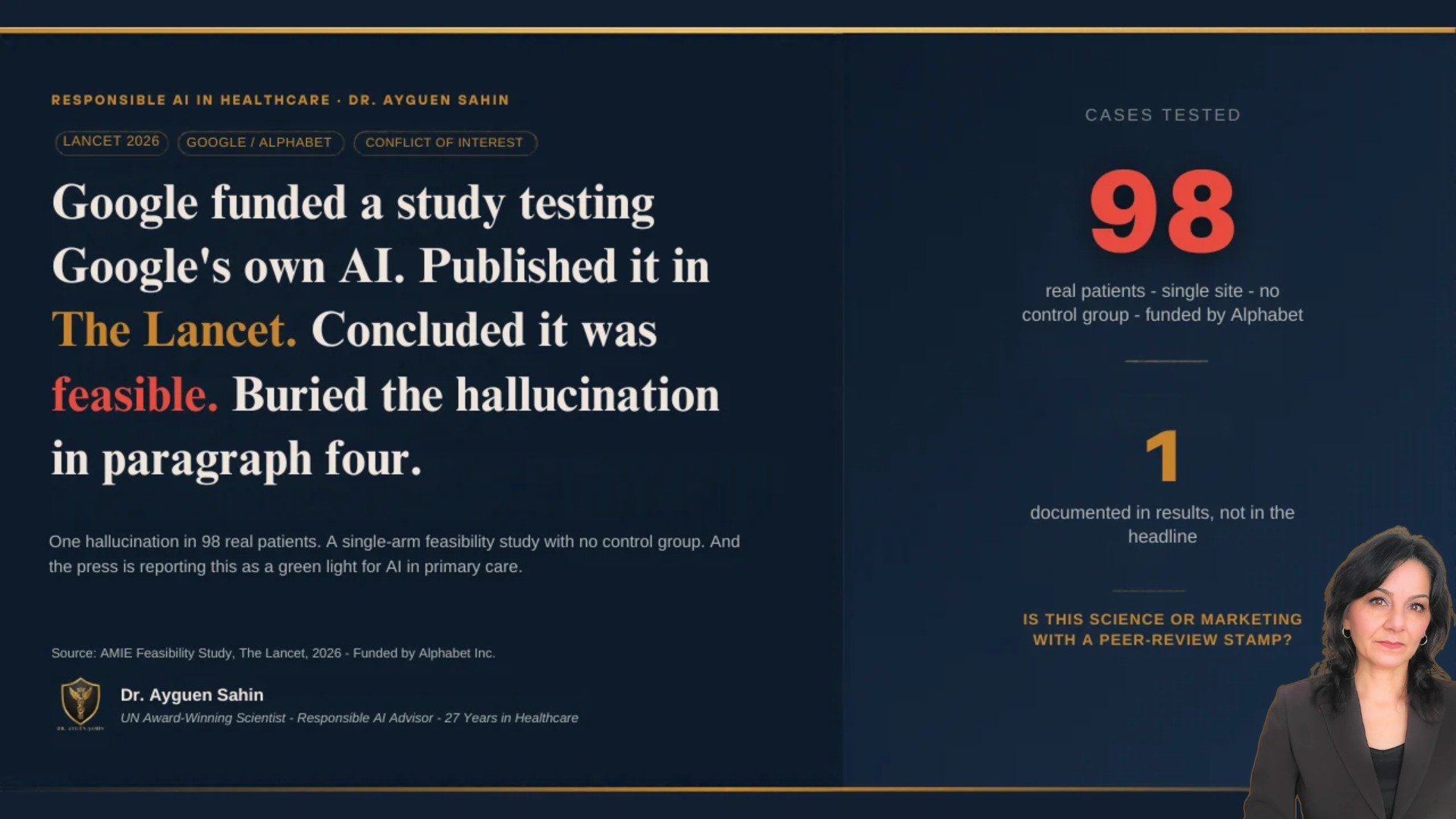
Google funded a study testing Google's ‘own’ medical AI, which was published in The Lancet. The “study” concluded that it was feasible, and buried the *hallucination* in paragraph four.
The study is called the AMIE (Articulate Medical Intelligence Explorer) feasibility study. Google's own conversational diagnostic AI, tested in real urgent primary care appointments with real patients at Beth Israel Deaconess Medical Center, Boston, MA. The lead author served as a visiting researcher at Google during the study. This “study” was funded by, of course, Alphabet.
The conclusion: broadly positive outcomes.
The hallucination: one documented instance.
Supervisors added clinical information in five additional interactions. That detail, meaning, real patients, real appointments, and real hallucination, sits in the results section without altering the headline.
I have been working at the intersection of science, healthcare, and patients for nearly 27 years. In that time I have watched the same pattern repeat itself: industry-funded studies designed to prove feasibility rather than to test it critically. The methodology and the peer review are real, and we are talking about real patients and real doctor’s office visits. This is as serious as it gets.
There are three things about this study that nobody in the coverage is addressing directly.
First: the consent question. In my ground-level experience with patients, 'informed consent' for medical or technology studies often means minimum prior education and maximum optimistic framing. Patients who do not fully understand what they are consenting to cannot meaningfully consent to it.
Second: the previous AMIE study that claimed it outperformed primary care physicians used patient actors, not real patients. This is the first real-world deployment, and the sample was 98 cases at a single center. That is not a safety, but a feasibility signal.
Third: data security. Patients' full clinical conversations, symptoms, and diagnostic reasoning, were fed into a Google-owned system, processed on Google infrastructure, in a study funded by Alphabet. Who owns that data? Where does it go? The paper does not address this.
I am not saying the research is fraudulent. I am saying that a study funded by the company whose product is being tested, published in the world's most prestigious medical journal, should be read with considerably more scrutiny than the coverage suggests.
If your hospital or health system is currently evaluating AI deployment in clinical settings, this paper is not a green light. It is a starting point for the questions you have not yet asked.
If your organization is navigating AI adoption in healthcare and wants a conversation grounded in nearly 27 years of on-the-ground clinical and scientific reality, rather than vendor feasibility studies, I am available for advisory consultations and speaking engagements. Details are in my profile, or contact me directly on my website drayguensahin.com/contact. This issue is of that importance and urgency.
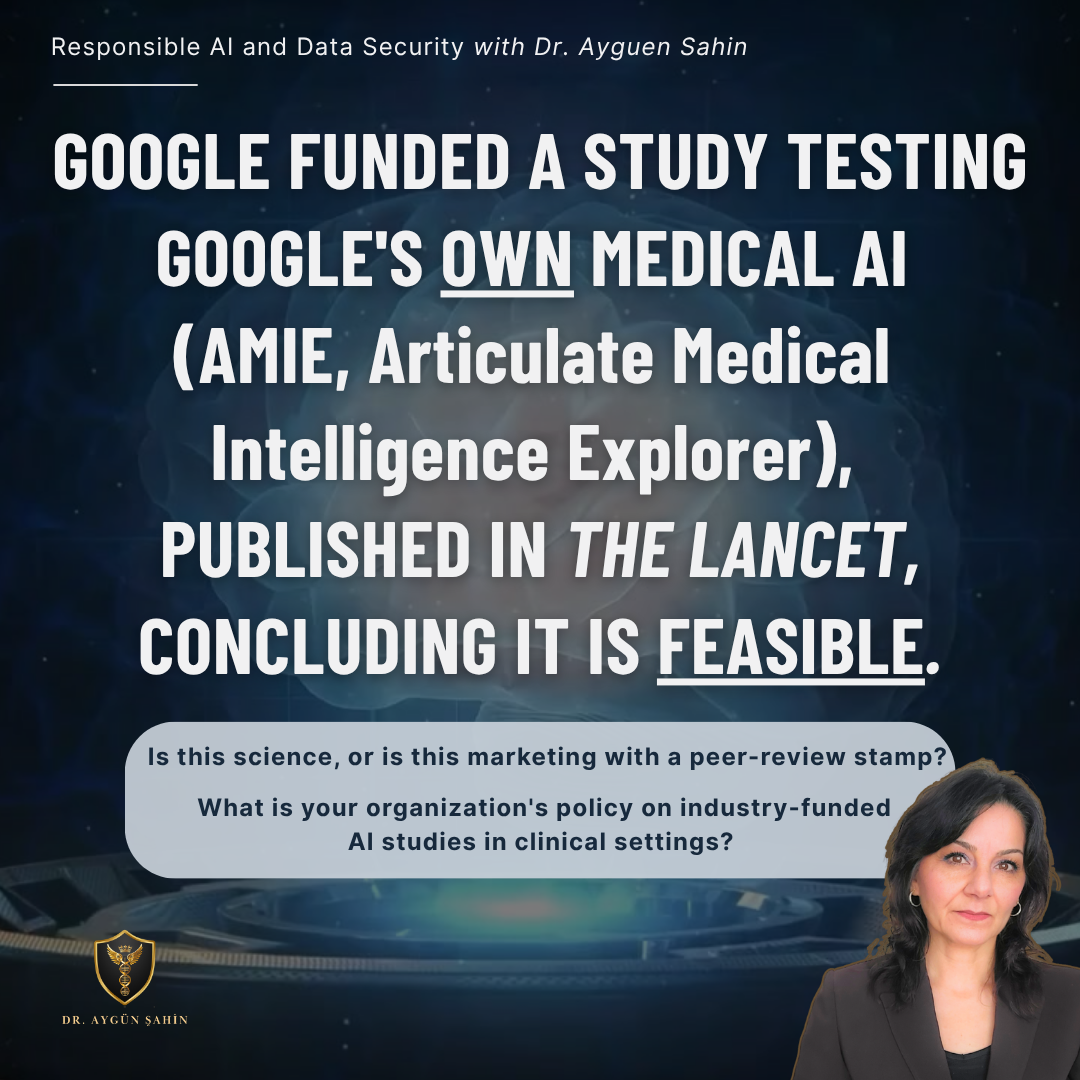
A Google-funded study testing Google's own AI, published in The Lancet, concluding it is feasible. Is this science, or is this marketing with a peer-review stamp? What is your organization's policy on industry-funded AI studies in clinical settings?
Original article: Conversational diagnostic artificial intelligence in ambulatory primary care: a prospective feasibility study
 I am very excited to announce that I officially launched my new Responsible AI and Data Security Youtube Channel: @ResponsibleAIwithDrAyguenSahin
I have been talking about AI’s possible dangers for society, humanity, and day-to-day lives since 2023 on my main YT channel. Last year, I launched my Responsible AI and Data Security consultation services on my website.
Last year, I warned nonprofits, small and client-facing businesses, and those in healthcare that the AI policy gap would become a crisis. Today, it’s a reality, and today, these very same organizations and companies are desperately looking for help in policy and AI integration!
I have been dealing with tech since 1998, and I’ve spent 26 years as a scientist protecting patient data. For the last 13 years, I have been implementing secure systems in our cancer organization, and we do have a robust and strict AI policy.
I’ve seen how quickly technology outpaces our human systems.
Last last week, I saw the call for help from our nonprofit community:
“We need AI education and policy implementation, and we need it now.”
I am answering that call.
My Youtube channel is now live! My channel is focused not only on AI as a “tool”, but also on protection, ethical frameworks, and policy for Nonprofits, Healthcare, and Small Businesses.
On this channel, I’ll be providing:
 Personally vetted AI tech reviews (what’s safe to use)
Step-by-step policy frameworks
AI education, especially for client-facing teams
As a scientist at a leading cancer organization, I live this every day. From our patients and families’ perspective, and from our organization’s and team’s perspective. If your organization is struggling with the 'Wild West' of AI, let’s get you secure.
 Watch the channel intro and the first video on the danger of deep fakes people around us here, and while there, please subscribe!
Book a consultation or education session:
You might like this product I designed
Do you procrastinate when triggered? Here is the solution: