
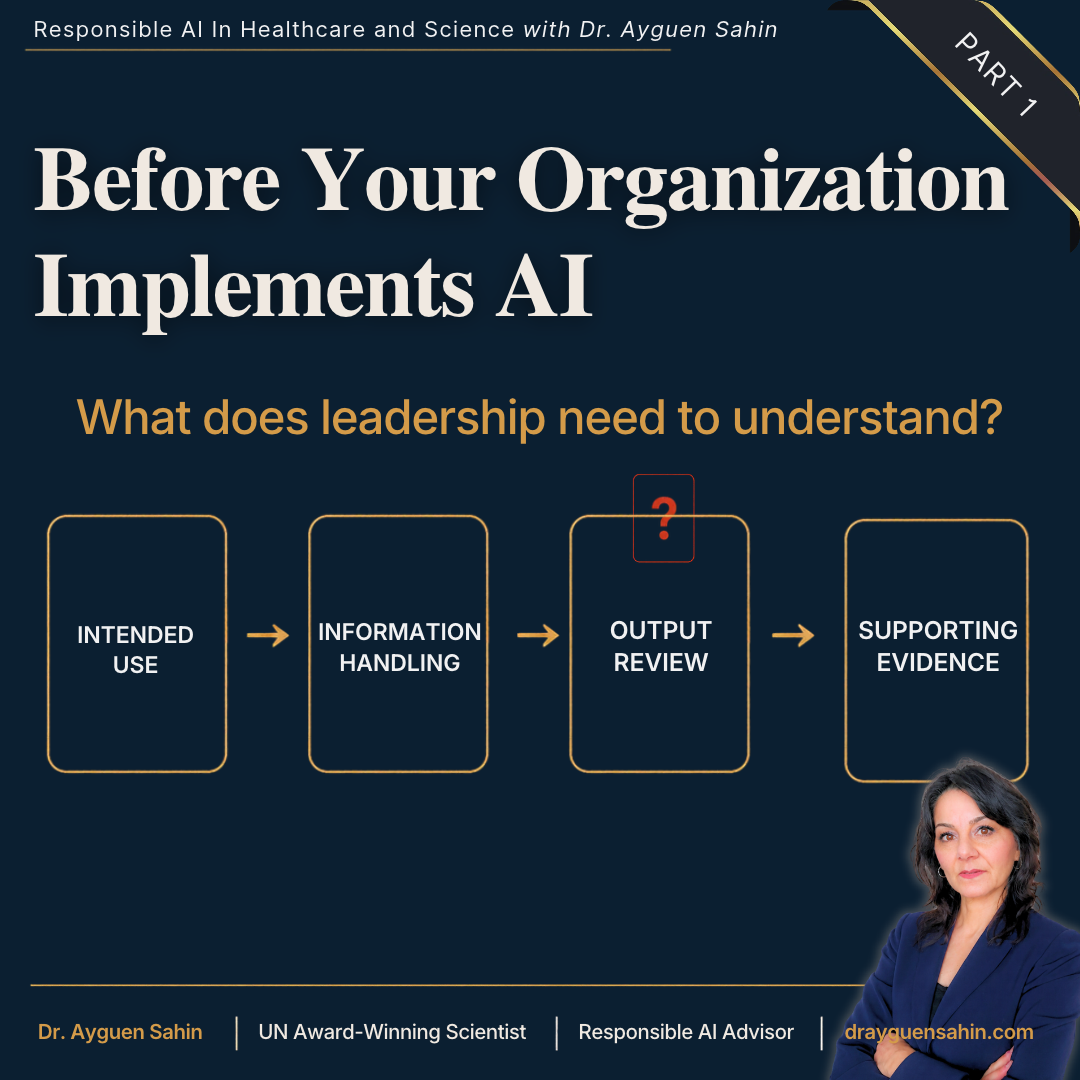
Before asking whether staff can follow an AI policy, I would ask whether the people approving the technology understand the proposed use.
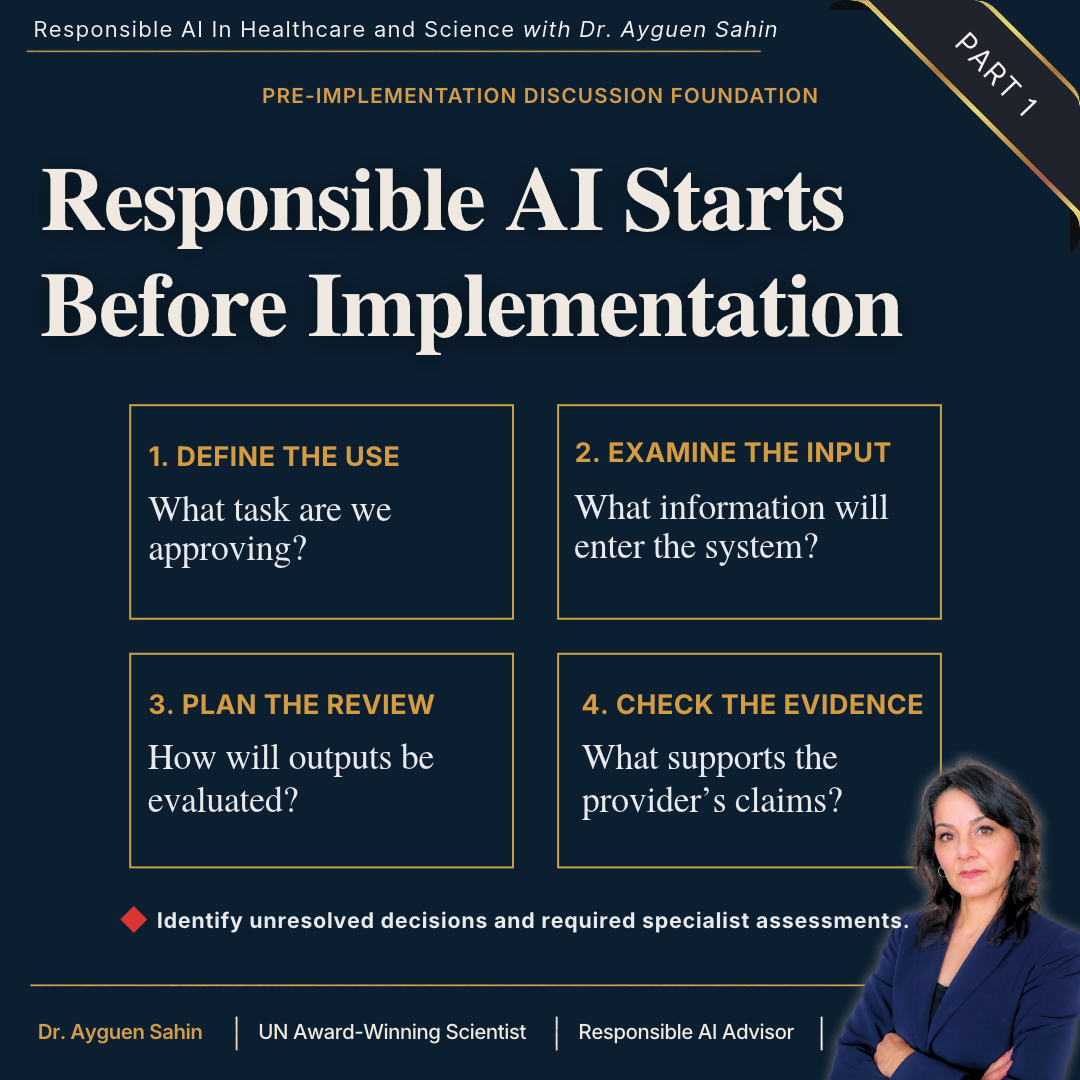
What does the tool do? What information will enter it? What does the provider claim, and what evidence supports those claims? How will the organization examine the output before anyone relies on it?
If those questions remain unanswered, I would begin there.
My perspective draws on 27 years in healthcare and science, involvement in technology since 1998, and 13 years implementing data-security and patient-safety practices within our global cancer organization. I have also implemented our organizational AI policy.
That experience informs how I approach responsible AI: understanding the technology and its intended use before translating decisions into organizational practice.
“Implementing AI” is too broad to guide a responsible decision.
I would want leadership to describe the specific task, the people affected, the information involved, and the intended result.
For example, a hypothetical proposal to help draft public educational material requires a different discussion from a proposal involving unpublished research or patient-related information.
Before proceeding, I would ask the team to complete this statement:
"We are considering this tool for this task, using this information, with these limits and this review process."
Uncertainty in that statement identifies work still to do.
A tool’s interface does not answer every question about the information entered into it.
I would want the relevant team to examine:
What information the task requires.
What the provider says about collection, storage, retention, access, and reuse.
Whether those statements apply to the account and configuration being considered.
Which information should be excluded.
What requires privacy, legal, security, or other specialist assessment.
The objective is to understand the proposed information flow well enough to make an informed organizational decision, not to assume that easy access means appropriate use.
An implementation proposal also needs to explain what happens after the tool produces an answer.
What would count as an acceptable result? How would an omission, unsupported statement, or misleading interpretation be identified? Who has the expertise and source material needed to check it?
I would want the team to define:
What must be verified.
What the output will be checked against.
Who performs that review.
Which uses require additional scrutiny.
What happens when the result cannot be verified.
“Human review” needs enough detail to explain how it will work for the intended task.
A demonstration can show what a tool produces in a selected example. My next question is what evidence supports its use in the organization’s actual setting.
When examining a study or provider claim, I ask:
What was tested?
Who conducted and funded the work?
What was the comparison?
Which users, tasks, or populations were included?
What limitations did the authors identify?
What remains untested in the proposed setting?
The purpose is to distinguish what the evidence establishes from what the organization still needs to investigate.
Once the organization has examined the intended use and its unresolved questions, it can establish practical expectations.
Those expectations should address permitted activities, information boundaries, output review, responsibilities, and how concerns are handled.
This is where staff education and scenario-based discussion become useful. People need to understand the decisions behind the guidance and how to apply it to their work.
My policy-to-practice approach therefore begins before the policy document: with the understanding required to make those decisions.
I work with healthcare and scientific teams examining a proposed AI use or reviewing how an existing initiative operates.
A focused engagement can help leadership:
Clarify the intended use.
Examine selected evidence and provider claims.
Identify information-handling and output-review questions.
Recognize where specialist assessment is needed.
Establish priorities for policy, education, and implementation planning.
The work is scoped around the organization’s circumstances. It does not replace legal advice, cybersecurity testing, clinical validation, or a formal compliance assessment.
If your team is considering an AI tool but cannot yet explain its information handling, limitations, review requirements, or unresolved risks, those are the questions to bring into the discussion first.
My Responsible AI working sessions provide a structured starting point—from understanding the proposed use to identifying the decisions needed for implementation.
For leadership programs, conferences, and university audiences, this discussion can also be developed into a tailored session.
Healthcare AI policy, Responsible AI implementation, AI policy to practice, Patient data protection, Human review of AI outputs, Responsible AI training for healthcare organizations
 I am very excited to announce that I officially launched my new Responsible AI and Data Security Youtube Channel: @ResponsibleAIwithDrAyguenSahin
I have been talking about AI’s possible dangers for society, humanity, and day-to-day lives since 2023 on my main YT channel. Last year, I launched my Responsible AI and Data Security consultation services on my website.
Last year, I warned nonprofits, small and client-facing businesses, and those in healthcare that the AI policy gap would become a crisis. Today, it’s a reality, and today, these very same organizations and companies are desperately looking for help in policy and AI integration!
I have been dealing with tech since 1998, and I’ve spent 26 years as a scientist protecting patient data. For the last 13 years, I have been implementing secure systems in our cancer organization, and we do have a robust and strict AI policy.
I’ve seen how quickly technology outpaces our human systems.
Last last week, I saw the call for help from our nonprofit community:
“We need AI education and policy implementation, and we need it now.”
I am answering that call.
My Youtube channel is now live! My channel is focused not only on AI as a “tool”, but also on protection, ethical frameworks, and policy for Nonprofits, Healthcare, and Small Businesses.
On this channel, I’ll be providing:
 Personally vetted AI tech reviews (what’s safe to use)
Step-by-step policy frameworks
AI education, especially for client-facing teams
As a scientist at a leading cancer organization, I live this every day. From our patients and families’ perspective, and from our organization’s and team’s perspective. If your organization is struggling with the 'Wild West' of AI, let’s get you secure.
 Watch the channel intro and the first video on the danger of deep fakes people around us here, and while there, please subscribe!
Book a consultation or education session:
You might like this product I designed
Do you procrastinate when triggered? Here is the solution: