Guiding organizations with strategic expertise in Responsible AI and personalized healthcare, while supporting individuals with NeuroHyperSensitivity™ through expert coaching and specialized programs.
FREE SELF-ASSESSMENT · DR. AYGÜN SAHIN · NEUROHYPERSENSITIVITY™ (NHS)
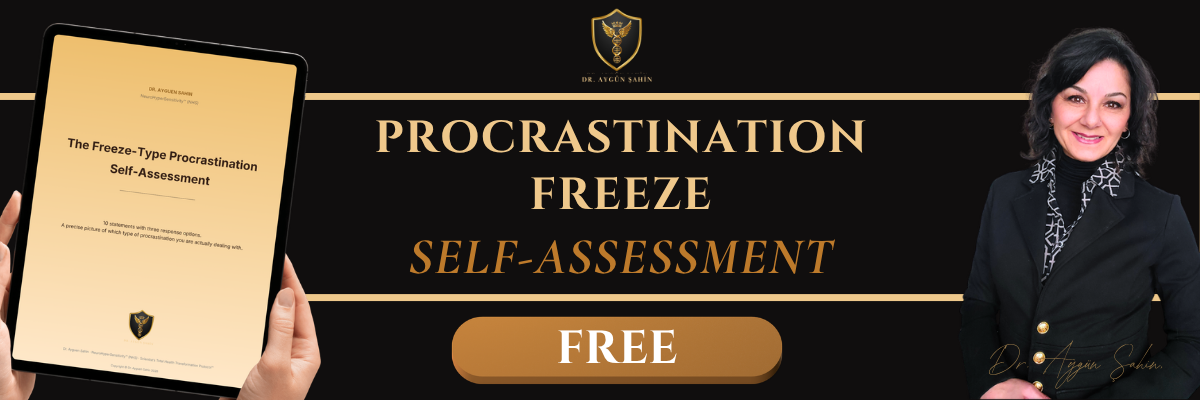
Procrastination Freeze: Why You Shut Down
Before You Can Even Begin, And What
Type You Are Actually Dealing With
10 statements, and it will take only 2 minutes. A precise result from a UN Award-Winning Scientist
who lived inside this condition, and built the solution nobody else was building.
You are neither lazy, nor unmotivated. Your nervous system has
learned - through stress, pressure, and accumulated traumatic experiences - that
initiating action is physiologically unsafe. This has nothing to do with you, personally. It is
a neurological state. It has a name. And, it can be changed.
- Dr. Ayguen Sahin, MSc, PhD
Is This YOU?
→ You know exactly what needs to be done. You sit down. Something shuts off.
→ You cannot open the email. You cannot start the document. You cannot begin the task, even though you are fully capable of doing it.
→ The harder you push yourself, the worse the procrastination freeze gets.
→ You have tried every productivity system, every timer, every method. The freeze is still
there.
→ And nobody - not a single book, course, or coach - has accurately described what you
are experiencing.
Until now.
There are two completely different types of procrastination. The entire "productivity industry" addresses one of them. This free assessment addresses the other - the one that shuts your nervous system down before you can even begin.
Freeze-type procrastination is not a "motivation" problem, neither an anxiety problem. It is a physiological state - one in which the amygdala has classified task initiation as threatening and taken the prefrontal cortex offline. No behavioral tool reaches a system in that state. No timer, no accountability partner, no system.
But first, you need to know which type you are actually dealing with. Because the approach that works for one does nothing for the other.
What Is Freeze-Type Procrastination, And Why It Is Different From
Everything You Have Read About?
Freeze-type procrastination is a physiologically distinct condition caused by nervous system
shutdown - not by a lack of motivation, discipline, or willpower.
Here is what is actually happening when you freeze: the amygdala, your brain's threat detection center, operating at approximately 20 milliseconds, faster than conscious thought, has learned to classify task initiation as dangerous. When it fires, it releases cortisol and functionally shuts down the prefrontal cortex. The prefrontal cortex is where planning, initiation, and executive decision-making live.
When the prefrontal cortex is offline, no behavioral tool can be received. A task list presented to an offline executive brain does not produce action. It produces more threat signal. The procrastination freeze deepens. The shame spiral begins. And the cycle compounds. This is why the harder you push, the worse it gets.
This is why everything you have tried has not produced lasting change. And this is why accurate identification of which type of procrastination you are dealing with is the single most important first step.
Applying behavioral tools to a nervous system in shutdown does not
produce initiation. It produces more threat signal. The freeze deepens. And you conclude, incorrectly, that something is fundamentally wrong with
you.
- Dr. Ayguen Sahin, MSc, PhD
Why Every Productivity System, Timer, and Accountability Method Has
Failed You
If you have ever felt like productivity advice was written for a different kind of person - someone
whose brain works differently than yours - you were right.
"Standard" procrastination advice is designed for "motivational procrastination" - the type where the nervous system is broadly regulated and the person delays for behavioral reasons. For that type, structure and accountability genuinely help.
Freeze-type procrastination is not that type. It compounds with chronic stress. It gets dramatically worse with age, hormonal changes, accumulated trauma, and sustained pressure. It responds to pushing by deepening. And it requires a regulatory approach - not a behavioral one - because the system must be regulated before any behavioral tool can be received.
The assessment you are about to take identifies which type you are dealing with, and gives you a specific, honest, science-based next step for your result.
Who Built This Assessment, And Why It Did Not Exist Before?
Dr. Ayguen Sahin is a UN Award-Winning Scientist, researcher, and the Founder of
NeuroHyperSensitivity™ (NHS), a neurological and genetic foundation she pioneered through her over 26 years of medical research background, scientific work, and lifetime advocacy as a person with NHS.
For the last three years or more, Dr. Sahin experienced progressive freeze-type procrastination as accumulated stress, anxiety, hormonal changes, trauma, and medical PTSD overwhelmed her nervous system. She reviewed the literature. She found nothing that addressed the condition at the level where it actually lived - the nervous system.
So she built it herself, because this freeze-type procrastination started to ruin her life, with missed opportunities, or dealing with the aftermath of "last-minute" correspondences. The protocols, the foundation, and the daily regulatory practice. All documented through the NeuroHyperSensitivity™ (NHS) Practical Neuroscience Masterclass series, 52+ masterclasses that form the scientific backbone of everything on this page.
This free self-assessment exists because the gap was real, the consequences were significant, and accurate identification should not cost anything.
What the Procrastination Freeze Assessment Includes
1)10 Statements: Each statement targets a specific marker of freeze-type procrastination - physical
sensation during shutdown, pattern progression over time, response to pressure and
discipline, and more. You respond Yes, Somewhat, or No.
2)A Precise Result in Three Categories: Freeze-Type Procrastination (7–10 Yes responses), Mixed Type (4–6 Yes), or Motivational Procrastination (0–3 Yes). Each category comes with a clinical explanation of what your score means neurologically, not just a label.
3)A Specific Next Step for Your Result: Not a generic recommendation. A direct next step tailored to your result category, whether that is the guidebook, the audits, or a different resource. Dr. Sahin does not recommend what does not apply to your type.
4)Dr. Sahin's Personal Note: Each result category includes a direct statement from Dr. Ayguen Sahin - in her voice, with the scientific precision and personal authority that comes from having lived inside this condition and researched her way through it.
This Is Not Another Generic Procrastination Quiz
Most procrastination quizzes tell you what you already know: that you procrastinate, and
that you should try harder, plan better, or hold yourself more accountable. This assessment
is different in one specific way: it identifies whether what you are experiencing is a nervous
system condition, not a "behavioral pattern". That distinction determines whether any tool
you choose will actually work. It is clinical in its foundation. It is honest in its
recommendations. And it was built by someone who needed it to be accurate, because her
own life depended on the precision of the answer.
The procrastination freeze is not the absence of motivation. It is the
presence of a nervous system that has learned - through years of stress,
pressure, and accumulated traumatic experiences - that initiating action is
physiologically unsafe. Understanding that is where everything changes.
- Dr. Ayguen Sahin, MSc, PhD
What the Community Says About Working With Dr. Aygün Sahin
I will definitely apply this, Dr. I tend to procrastinate when I get triggered.
- Sarah, Community Member
I was struggling and feeling overwhelmed with some very important goals. The breathing
technique is helping me daily. I truly needed these tools and direction.
- Amber, Program Participant and Long-Term Community Member
Dr. Sahin's techniques truly work - based on science.
- Amber
If You Have NeuroHyperSensitivity™ (NHS), Here Is Why the Freeze Hits
Differently
Individuals with NeuroHyperSensitivity™ (NHS) - a distinct neurological profile identified and named
by Dr. Ayguen Sahin, MSc, PhD - carry a nervous system that processes the world with greater intensity,
sensitivity, and reactivity than most.
When we are younger, this hypersensitivity often makes us exceptionally driven, acute, and capable. We are not the people who freeze. We are the ones who deliver.
But as stress accumulates - as life layers trauma (because we must cope with this overwhelming world more intensely than most), stress, hormonal shift, PTSD, and more - that already-sensitive nervous system reaches a threshold. The freeze begins. And it compounds faster, and more severely, than it would in a less sensitive system.
If you have always felt your nervous system operates at a different intensity than most people around
you, and if the procrastination freeze has become progressively worse over time, this
assessment was built for your specific neurological profile.
Are You Ready To Find Out Which Type You Are Dealing With?
Frequently Asked Questions
Freeze-type procrastination is a physiologically distinct condition in which the nervous system shuts down before task initiation is possible. Unlike "motivational procrastination", which responds to behavioral tools like timers and accountability, freeze-type procrastination is driven by amygdala activation and prefrontal cortex shutdown. It requires a regulatory approach rather than a behavioral one.
Chronic cortisol elevation progressively sensitizes the amygdala and degrades prefrontal cortex function. Hormonal changes alter dopamine and serotonin regulation. Accumulated trauma and adverse experience create stored threat memories that future tasks activate automatically. All of these compound over time, which is why freeze-type procrastination becomes progressively more severe under sustained life pressure.
No. The Freeze-Type Procrastination Self-Assessment is an educational and self-identification tool
created by Dr. Ayguen Sahin based on her scientific background and foundation, and life experiences. It is not a
medical diagnosis. If you are experiencing significant clinical symptoms, please consult a qualified
healthcare provider.
You receive a precise result in one of three categories - Freeze-Type, Mixed, or Motivational - with
a scientific explanation and a specific next step. You will also receive emails from Dr. Ayguen Sahin
with practical neuroscience content, resources, and tools relevant to your result.
Yes. Completely free. No payment required. Dr. Sahin built this assessment because
accurate identification of procrastination type should not be behind a paywall it is the most
important first step toward choosing an approach that will actually work.
About the author
Aygün Sahin, MSc, PhD
Scientist · Biomedical Researcher · Founder, NeuroHyperSensitivity™ (NHS) · Scientist's Total Health Transformation Protocol™
I wrote this guidebook because I needed it
and it did not exist. As a scientist with a biomedical research
background, I went deep into the neuroscience while living inside this
condition, and found what actually works. Not in theory. In practice.
Every day. The NeuroHyperSensitivity™ (NHS) Practical Neuroscience
Masterclass series, which forms the backbone of this guidebook, is the
documented record of my work and my protocols. This is the resource I desperately
needed, built for the people who need it most.
Questions? Contact me. I respond personally to everyone.
Aygün Sahin, MSc, PhD
Neuroscience-Based Solutions for Real Life
NeuroHyperSensitivity™ (NHS) · Scientist's Total Health Transformation Protocol™