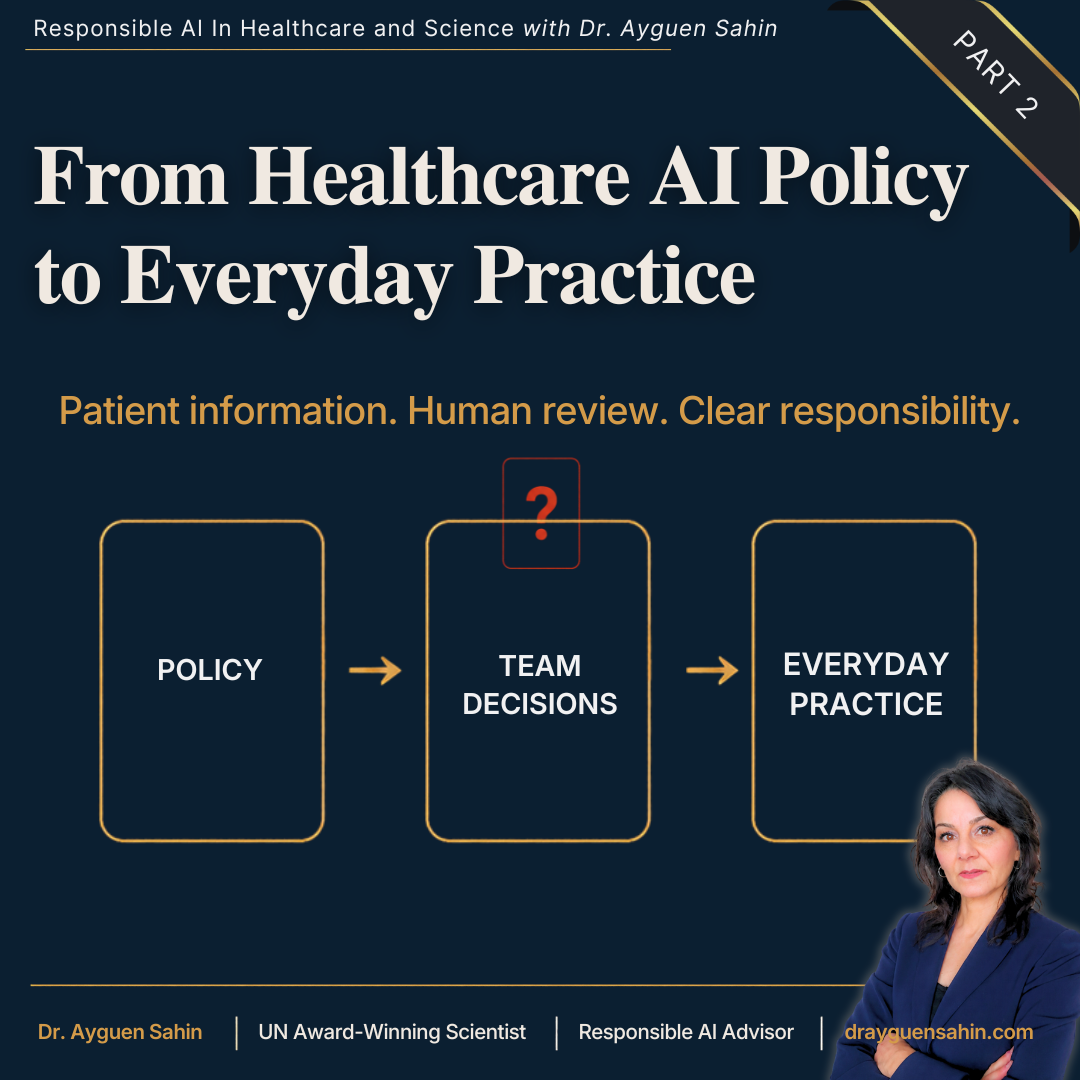
Your healthcare organization has an AI policy. Can your team explain what it means for the task in front of them?
A staff member wants to use an AI tool to summarize a document. They have read the policy, but they are unsure whether this particular use is permitted.
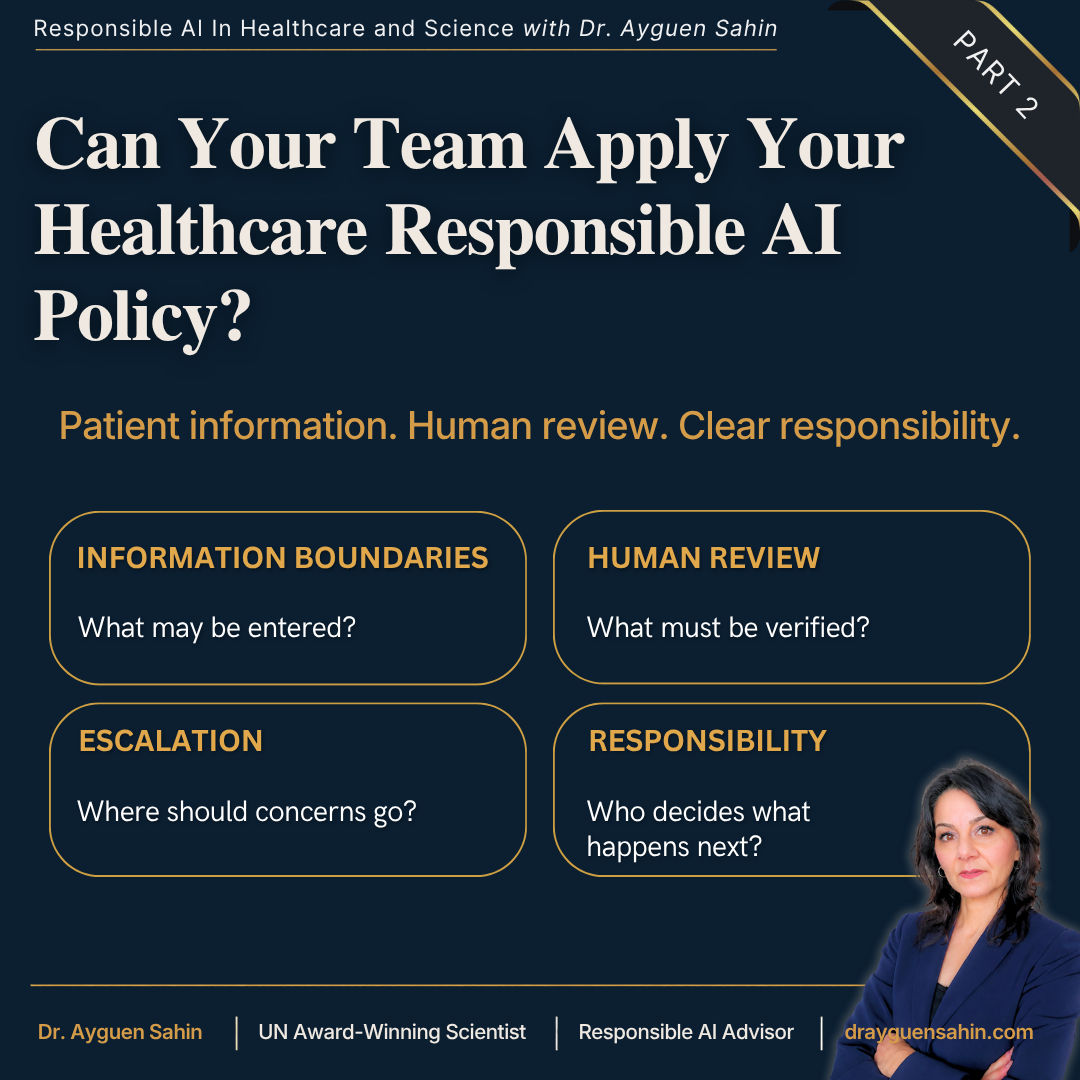
What information may they enter? What must they verify? Who should resolve the uncertainty?
These are practical questions about responsible AI in healthcare.
My perspective draws on 27 years in healthcare and science, involvement in technology since 1998, and 13 years implementing data-security and patient-safety practices within our global cancer organization. I have also implemented our organizational AI policy.
That experience informs how I connect responsible-AI principles with organizational decisions and everyday work.
For me, responsible AI involves examining the intended use, protecting sensitive information, evaluating evidence and outputs, and maintaining clear human responsibility.
An organizational policy should help people understand what those commitments require in their role.
Consider a hypothetical situation: a researcher has used an AI tool to summarize public material. A colleague now wants to use it with an unpublished document.
Before proceeding, I would want the team to establish:
Whether approval covers this task and category of information.
What information-handling questions need further assessment.
What review would be required before using the output.
Who can resolve anything unclear.
The responsible-AI discussion concerns the task, the information, the people affected, and the conditions under which use may proceed.
A general instruction to “protect patient data” leaves practical questions to resolve.
I would want staff to understand which information is permitted, which requires additional review, and where to take a question before entering sensitive material.
The same discussion can extend to unpublished research, confidential correspondence, and other information an organization is responsible for protecting.
My focus is on helping teams identify where assumptions need to become explicit decisions.
Responsible AI also requires clarity about what happens after an output is generated.
Who checks it? Against which sources or criteria? What happens if the reviewer cannot establish that it is suitable for the intended use?
For a hypothetical patient-education document, the discussion might address accuracy, omissions, wording, and suitability for the audience. For a scientific summary, it might address source material, references, interpretation, and uncertainty.
The appropriate review depends on the task and the expertise required. “A person will check it” needs enough detail to guide the work.
An organizational policy should give people a clear route for raising concerns.
If someone encounters unexpected behavior, an unsupported claim, or an output they cannot verify, I would ask:
Who receives the concern?
What should be documented?
Who evaluates it?
Should the activity pause while it is reviewed?
How is the decision communicated?
These questions connect responsible-AI commitments with organizational accountability.
A case-based discussion can help a team examine whether its guidance is understandable.
Present a clearly hypothetical task and ask participants:
Which part of the policy applies?
What information is needed before proceeding?
What must be reviewed?
Who resolves the remaining questions?
Different interpretations can reveal a specific issue to clarify.
This is a discussion aid—not a security assessment, clinical validation, or determination of compliance.
The policy document is one part of the work. My focus is how its expectations connect with the decisions people make: what they enter, what they verify, when they pause, and who remains responsible.
I work with healthcare and scientific organizations at two connected stages:
Before implementation: examining a proposed use, its supporting evidence, information-handling questions, and assessment needs.
During implementation: connecting those decisions with organizational policy, staff education, human review, and responsibilities.
Each engagement is scoped around the organization’s circumstances. It does not provide access to our cancer organization’s internal materials or assume that its policy can be transferred unchanged.
If your team is evaluating an AI tool—or has a policy but still needs to clarify how it applies—my Responsible AI working sessions provide a structured starting point.
We examine one current initiative and identify the decisions, responsibilities, and specialist input still needed.
Healthcare AI policy, Responsible AI implementation, AI policy to practice, Patient data protection, Human review of AI outputs, Responsible AI training for healthcare organizations
 I am very excited to announce that I officially launched my new Responsible AI and Data Security Youtube Channel: @ResponsibleAIwithDrAyguenSahin
I have been talking about AI’s possible dangers for society, humanity, and day-to-day lives since 2023 on my main YT channel. Last year, I launched my Responsible AI and Data Security consultation services on my website.
Last year, I warned nonprofits, small and client-facing businesses, and those in healthcare that the AI policy gap would become a crisis. Today, it’s a reality, and today, these very same organizations and companies are desperately looking for help in policy and AI integration!
I have been dealing with tech since 1998, and I’ve spent 26 years as a scientist protecting patient data. For the last 13 years, I have been implementing secure systems in our cancer organization, and we do have a robust and strict AI policy.
I’ve seen how quickly technology outpaces our human systems.
Last last week, I saw the call for help from our nonprofit community:
“We need AI education and policy implementation, and we need it now.”
I am answering that call.
My Youtube channel is now live! My channel is focused not only on AI as a “tool”, but also on protection, ethical frameworks, and policy for Nonprofits, Healthcare, and Small Businesses.
On this channel, I’ll be providing:
 Personally vetted AI tech reviews (what’s safe to use)
Step-by-step policy frameworks
AI education, especially for client-facing teams
As a scientist at a leading cancer organization, I live this every day. From our patients and families’ perspective, and from our organization’s and team’s perspective. If your organization is struggling with the 'Wild West' of AI, let’s get you secure.
 Watch the channel intro and the first video on the danger of deep fakes people around us here, and while there, please subscribe!
Book a consultation or education session:
You might like this product I designed
Do you procrastinate when triggered? Here is the solution: